How I learned Japanese | Behind the struggle

First, thank you guys
Before I start my post today, I just wanted to thank everyone for all of the support and comments that I received on the last blog post. In the near future I plan on adding a reply feature to the comment section so I will be able to reply to you guys directly, as well as helping foster a community where you all could reply to each other as well if you wanted.Small disclaimer
This will be a more text heavy and longer blog post. I will be trying various forms of blogs. Some with multiple photo and videos; some more story and text focused. For the zoomer ADHD brains I am sure it is easier to follow along with the photos and videos in this day and age. But I still think text based blogs still have a place in modern society. (I mean people still read books right?) If you find this blog post too long, feel free to just skim the headlines and read the interesting sections. Or just take a break and come back later. If you have feedback on the blogs I'd love to hear them at kyle@kylesjapan.life .My Japanese Journey
Today I would like to go in depth and explain my journey with learning Japanese and how I was able to go from not being able to speak a single word, to passing N1, the highest level of Japanese proficiency that you can achieve. Now let me start by saying I am in no way good at Japanese still. While I have indeed passed the N1, it is still a relatively low score and I have friends who are way better at both speaking and writing Japanese than I am.
But wait a minute... First off, what even is this JLPT N1 nonsense you are talking about?
Yea, I should probably explain. The JLPT, also known as the Japanese Language Proficiency Test, is the defacto, standardized test for proving Japanese language ability. There are 5 different tests which go from N5 which is the lowest beginner level, to N1 which is the highest level you can take. Now, there is a lot of criticism in the Japanese learner community around the test saying that it doesn't actually really prove Japanese ability because there is no speaking or writing portion, and they are partially right about that. I have met people at N2 level that can barely even speak Japanese at a functional level.
But there isn't really a more standardized test than this for Japanese that exists. I mean heck, it's even officially recognized by the Japanese government and is a possible determinant for getting permanent residency here. So while there's no speaking or writing portion, you still need to understand how to read kanji, understand Japanese grammar and understand spoken Japanese. It's not an easy test. Only around 20% of the people that take it actually pass. For Chinese people whose whole language is literally already Kanji, it's fairly easy to pass without having to speak. But for an American it is quite hard.
For those curious, here is a chart with estimation for how long it takes to pass each level. Courtesy of CotoAcademy.
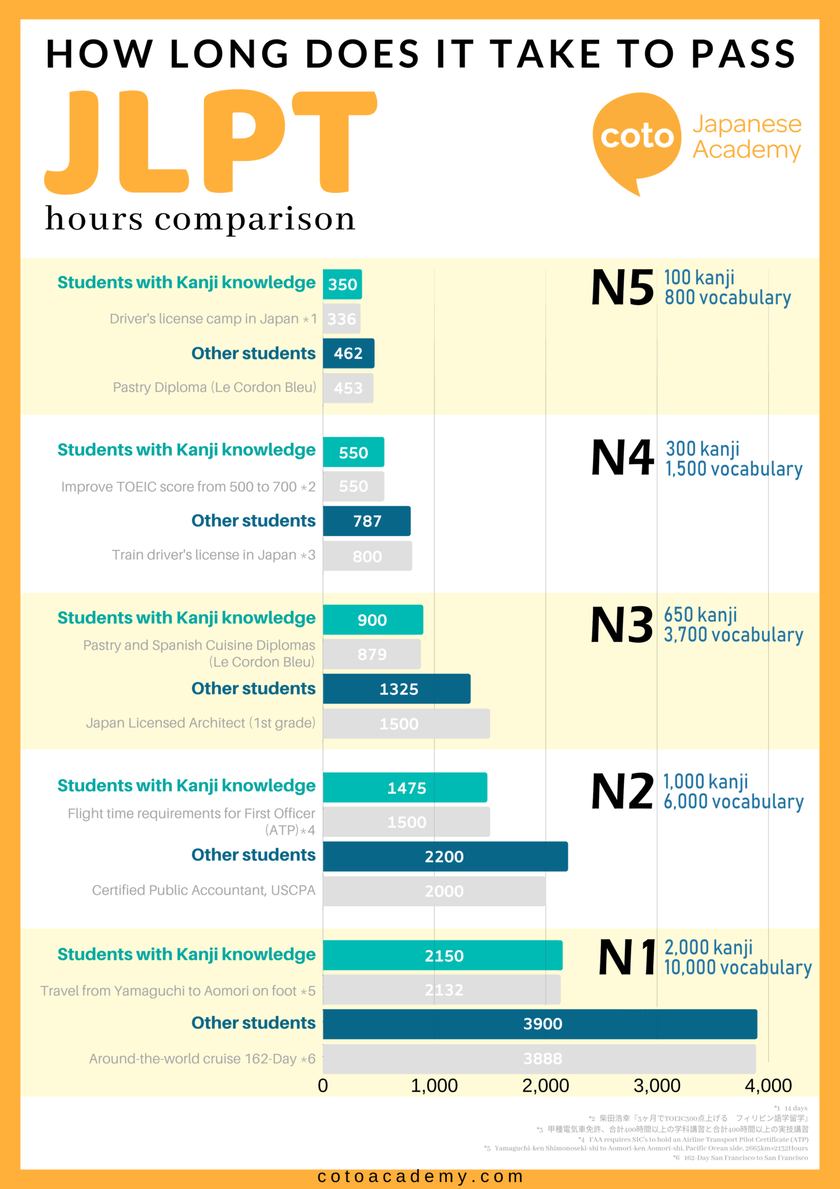
Hey, look at that. 3900 hours to pass N1 for those without previous Kanji knowledge. Nice.
My motivation for learning the language
I started learning the language around 2019. If I really went back though, I think I started reviewing flash cards of Japanese words and lightly studying grammar around the end of 2018. It was around this time that I started to have a strong desire to visit Japan. Also around this time I was working a part time job at a retail store called Target. My job? Pushing carts. Pushing carts in both the freezing snow as well as the blistering heat. Don't forget during thunderstorms as well. (Yea that happened a few times.)
At this point in time all I really had ever known was my small hometown of 2000 people. My whole life I lived in the country side of America. I lived in the kind of town where everyone knows each other. The kind of town where you marry the first person you ever date in high school, continue to live in said small town and then start working at the very high school you graduated at as a teacher. Yes this is a real story. Point is, most of (I'm talking like 95%) of the people in my graduating class and heck even the school itself had never even flown on a plane, much less left the country.
It was in part this desire to experience a culture other than my own, a desire to break out of the small town mold that I grew up in and discover something new. Discover who I really am and what I wanted to be, that pushed me to study and learn Japanese and go to Japan. And let me tell you I have absolutely 0 regrets but...
Getting money to pursue your dream isn't easy
While I technically started my Japanese learning journey in 2018, my true journey didn't start until October 2019, which was when I finally first came to Japan. I also want to mention the trip to Japan was completely self funded by me. I knew from 2018 onward, that I wanted to go to Japan and challenge myself to learn the language, so I did everything in my power to get enough money to make it happen, including working two jobs.
That's right, I also got a part-time job at Amazon in order to save up money. There was a time where my schedule was literally like this:
- Wake up at 5:30am
- Start shift at Amazon at 6am
- Work until 12:30pm and end my shift
- Head to my second job at Target
- Quickly eat and change into uniform in the car
- Start my next shift at 1:30pm and work until 11pm
Yea I would work for 14 hours a day. All so I could afford to go to Japan. For reference, the tuition for the language school I went to was around $7,500. By the time the due date came around for it, I was able to pay it all in cash. By the way, if you're curious what $7,500 looks like in $20 bills, here it is.
Yea there's a whole story behind that but we don't have time to get into it today.
Landing in Japan for the first time
It's probably obvious but going to Japan for 2.5 months helped tremendously in learning Japanese. This was my first time actually being forced into a situation where I had to speak Japanese every day. Up until then I don't think I had actually ever spoken Japanese out loud in my life. Like I remember being at the airport after landing for the first time in Japan. After landing, there was a waiting room we were instructed by our language school to go to where the group of students for the semester would all gather and then we would be taken to our host families.
I remember talking to the guy in charge of the program as we were waiting, and asking him (in English) where the nearest ATM was. After he told me, I figured I needed to at least say thank you in his own language. I mean, I was now in Japan after all. But having not even practiced speaking the language a single time, I was super nervous to even say ありがとうございます, which is thank you in Japanese. Yea, that was actually the first word of Japanese I ever spoke out loud. It felt so foreign and weird for me to speak Japanese. Like I'm not even Japanese, what right do I have to speak this language, especially with terrible pronunciation to boot. It was after that moment that I knew I had a long road ahead and I needed to force myself to speak daily if I wanted to make any progress.
That night I was introduced to my host mother. An elderly woman in her mid 80's who rode a moped everyday and owned her own omelet rice restaurant, a popular food in Japan. She didn't speak any English at all. Like any. So the first night I was there she was explaining everything to me in Japanese like where the toilet and shower was, when food would be ready etc and I hardly understood any of it. But this was one of the best situations I could have been in because it forced me to speak Japanese.
The next morning when I got to the language school, they made us take a test to measure our Japanese ability. At the time I had already been studying some Japanese the past year, so I thought "Ok, at least I won't get the lowest level right?"
I literally got assigned to the lowest class level available
That's right, I did so bad on the test they literally put me in the beginner of beginner classes. The one that makes you learn the Japanese alphabet, Hiragana and Katakana from scratch. "But I already learned those, this isn't fair". I thought to myself. They gave me another chance to write Hiragana and Katakana on paper to test my ability.
I couldn't even write the most basic of characters
I got to about か on the alphabet chart and gave up. Before coming, I memorized the Japanese alphabet but I had never actually practiced writing before. This lack of output of Japanese was a core hindrance for me in more ways than one.
For those curious, this was my language school beginner class. There were two other American guys, with the rest of the class being primarily Chinese and Korean. Chinese being the largest. You can see the other white dude's head just barely in the back right. The guy directly underneath the clock was actually one of the teachers.
Looking back, I am incredibly grateful and glad that I got put into the lowest level. If I hadn't, I don't think I would have even learned how to write properly. They made us write the whole alphabet many times over by hand so I literally had to practice if I wanted to pass the class. If I got put into even one level higher of a class, I would have failed because they required you to start writing Kanji, in addition to the alphabet, which I couldn't even write.
Even now, I still haven't practiced writing Kanji. And to be honest I don't really feel a current need to. In this modern digital age, the only time I have actually had to write anything in Japanese is at the city hall, and even that just includes my address and name which can be easily memorized. Maybe one day if I decide to naturalize, I can go hard into practicing writing but for now I am fine with my current level.
Speaking of Kanji...
How exactly did you learn and memorize over 2000 Kanji characters Kyle?

Kanji was without a doubt the hardest part of learning Japanese. I surprisingly was pretty decent at Japanese grammar and didn't have much problem with it, but Kanji, especially for an American with no previous history in an Asian language, is quite difficult at first. I was lucky to find a website early on called WaniKani. To those who are interested in learning Japanese, I highly recommend this website for learning Kanji. Just make sure you install a lot of custom plugins as the vanilla version of the site low key kind of sucks.
I started WaniKani in January 2020, right around after the time I came back from the language school. Having just had the best time of my life in Japan, I was super depressed to come back to America and return to my normal life. But this sadness only pushed me and motivated me to learn Japanese more as I knew that I had to get back to Japan. No matter what.
So, I started with the complete basics of Japanese Kanji 一、ニ、三 (one, two, three) and slowly worked my way up to stuff like 機器、飛行機、人間 (device, plane, human). To those of you who haven't studied Japanese you probably looked at those kanji and were thinking "wow those seem really hard". I'm sorry to say but that is literally still beginner kanji. That is like N4-N3 level. There are 60 levels in WaniKani with level 60 finally getting to the difficult N1 kanji but from 2020 until I made it to Japan again in 2022, I got to around level 25 or so before I burnt out and stopped practicing.
During 2020-2022, I was still in college and thankfully UTK had Japanese classes, so I jumped on the opportunity to sign up for them. After doing the language school, which was actually quite an intensive course, I somehow was already at the intermediate-advanced level for the classes. Like, I literally emailed the Japanese professor asking what level class I should be in and she said I should join the highest level class they have available at UTK. Pretty crazy for only going to a language school for 2 and a half months.
Unfortunately, due to covid, literally everything was online, so in those 2 years I didn't have a single face to face class with any of my classmates, and couldn't speak Japanese in person. I'm still glad I signed up for the classes though, as it helped a ton in keeping me consistent with Japanese, and learning a lot of new grammar that I still didn't know.
I was still doing Kanji on WaniKani little by little during this time, but there was just certain point when I just stopped. After a while, if you don't do reviews, they start to pile up so you could go from having around 100 daily reviews to do, to having a mountain of 1000+. It eventually got to this amount, so it was hard to find the motivation to go through that whole pile, especially when I wasn't in Japan.
That leads me to...
Coming back to Japan
Coming back to Japan was probably the best thing that has ever happened in my life. A year before graduation I applied to the JET Program, which is an English teaching job sponsored and backed by both the American and Japanese government. Now, I had absolutely 0 interest in teaching English. I had no plans of making a career out of it. But at the time, due to covid, literally no one except native Japanese people could enter Japan. Even people on permanent and long term visas couldn't enter the country. I even had a study abroad program lined up that got canceled. I was set to study abroad at Waseda, which is a fairly high and prestigious college in Japan, for 1 year. But due to covid and restrictions, all of that got completely canceled. While sad, I was still determined to find a way into Japan, so that's when I started searching and found the JET Program.
The program requires 2 letters of recommendations to even apply. Thankfully, because I took Japanese classes the past 2 years at my college, I had 2 different Japanese professors that could give me a letter of recommendation. And even better; that I was apparently one of the top students in both classes that had some of the highest grades. (Yes I took a peek at the recommendation letter to see what the professor said).
Now while both of the professors were native Japanese, one of the professors was a quite prestigious and highly credited professor that even had their own book. I think this recommendation letter from them was one of the driving factors that helped me get into the program.
The interview
Now, while I did eventually get into the program, I actually didn't get in at first. The interview was around February and while I didn't think I did that bad, I also don't think I did well either. I mean, I didn't even want to teach English in the first place, I just wanted to get into Japan. But during the interview, there was a Japanese portion at the end where a native Japanese panelist asks some questions to you in Japanese. Once again, thanks to my studies at both the language school and 2 years of University classes, I aced this portion with no issues. If anything was going to beat the odds and help me get the job it would be that. Until..
Placed as an "alternate"
When I got the email that I wasn't on the shortlist and accepted into the program I was devastated. It was around April 2022 and Japan was still locked shut. At this point, I had no other back up options. I knew no matter what I wanted to go to Japan but with this door seemingly closed and graduation quickly coming up, I had to think of something fast. I had already started coming up with a new plan of trying to study abroad again at a language school for the Fall and was trying to apply to Target again so I could start saving up money to go again. Pretty much a repeat plan of 2018-2019.
That's when I got the call
I was actually sleeping at the time but after looking at my phone I saw "1 missed call from the Nashville Japan Consulate". Even being half awake I knew what this meant.
I got the job!
I guess someone had dropped out of the program and an opening became available. Being on an alternate list meant that I wasn't guaranteed a position, but if someone decided not to go, someone from the list would be picked and put in their place instead. I guess I was fairly high on the alternate list because it was about 3 weeks or so after getting the initial email that I got the call. After graciously accepting the job offer, I knew this was it. My life in Japan was actually about to begin.
Still, at this point I didn't know exactly what part of Japan I would be placed in. I of course was hoping for Tokyo, as are most people applying to the program. I remember around the middle of June I had just got out of the shower when an email came on my phone. "[JET Program Placement Notification]". This was it. Let me see what I got...
Muroto? What is that

I got placed in a little fishing town with a population of 2000 people. Nothing even remotely close to Tokyo. Even still, I was incredibly grateful to even be in Japan and knew that even if I was in the country side, I would still find a way to make it work.
Muroto was the best thing that could have happened for my Japanese learning journey
If I thought talking to a single host mother in only Japanese was difficult, boy would I be in for a challenge in Muroto. Hardly anyone spoke any English. Not even teachers. Yes that's right. Now let me say that I taught both Elementary school and Middle school. The Middle school teachers actually spoke English and it was pretty good to be honest. But the Elementary school teachers were another story... You see, in Japan, English is a required subject from Elementary school onwards. The thing is, for Elementary school, you have essentially one homeroom teacher and they teach all the subjects. Math, science, Japanese... English.
Yea, so these teachers are expected to teach every subject, but the problem is none of them actually learned English. It has only recently become part of the national curriculum, so it's required, but the teachers themselves can't speak it. That lead to interesting situations where it is supposed to be an English class lesson but literally everyone, the teachers and the students included, are all just speaking Japanese. Fortunately, the Middle school teachers that taught English, specialized in only teaching English, so their English and their lessons were actually quite good.
Anyway, being in these Elementary schools required me to have to speak Japanese if I wanted any chance of communicating with the teachers or students. And of course, this in turn helped a lot in learning Japanese.
Additionally, there was a local restaurant I went to in Muroto nearly every week. There, a lot of local Japanese that lived in Muroto, went there to sing karaoke and hang out. It just so happened that a lot of the customers were literally the exact same age as me and we all graduated around the same time. This was an incredible coincidence and helped a ton in developing relationships and friendships with the local Japanese there. This was probably the thing that helped my Japanese improve the most.
All the locals spoke with a strong Tosa-ben accent which is a specific regional dialect in Japanese. It was way different than normal Japanese and normal words change into completely different ones. For me learning Japanese, this presented a pretty big challenge at first but practice, practice, practice is the key. By the end of my year in Muroto, I was actually able to communicate naturally with the locals there and understand the majority of what they were saying.
I even had the opportunity to give a full presentation on the differences between Japan and America to a retirement home, completely in Japanese. They wrote an article about me in the newsletter.
Trying the JLPT for the first time
Half way through the year, in December 2022, I decided to take a go at the JLPT. Up until now, I hadn't even taken the test before, so I had no idea what to expect or even what level I was at. I figured N5 and N4 were a little too low for me at this point, but N2 also seemed a little too difficult still. I decided to give N3 a shot. A nice in the middle sort of test.To my surprise, I passed it. Not just passed it, I passed with a fairly high score as well.
As I was leaving Muroto and heading to Yokohama to move into the city life with a new job, I also took N2 in July 2023. I also passed it first try.
It's safe to say my time in Muroto and talking with the local Japanese people there everyday was the main reason that I was able to pass both the N3 and N2 so easily. It was the best thing that could have happened to me for learning both Japanese language and culture and I'm so glad I wasn't placed in Tokyo for my placement.
That leads me to my final topic and the main beast of Japanese language learning...
Passing the N1
After coming to Tokyo, working in a Japanese company and speaking Japanese daily. I thought I might be ready for the N1. I signed up for the N1 and took the test in July 2024. I had just quit my previous job and was unemployed. I quit in June so I had about 1 month to study as hard as I could and try and pass it. Let me just check the test results... this should be easy-
Wait, I failed???
Having passed both the N3 and the N2 first try, I was devastated. I'd never failed a Japanese test in my life before. Not even in college or the language school. Had I underestimated the N1? I was so sad I literally rode my bike around Tokyo until 5am that morning. I had to think of a new game plan.
Looking at the results, I noticed that reading was my lowest scored section. I saved the reading portion of the test for last when I took it. On the first half of the test, there is Vocabulary, Grammar and Reading. You have to complete all three within 110 minutes. If you go through them in order, you'll more than likely find yourself running out of time. I was the fool who didn't skip around and just went completely in order and by the time reading came around I was already running out of time, forcing me to skim read, thus missing the main points of the stories and a ton of questions.
Here's what an average question from the reading in N1 looks like.

I had to change my strategy. With the help of Yukina, I studied both grammar and reading hard. I bought a bunch of Japanese books as well as N1 practice textbooks and would go through them with her. Anytime there was a word or grammar I didn't understand, I would have her explain it to me. We did this for a few months; coupled with talking nearly daily in Japanese with her.
Also remember WaniKani I talked about earlier? Yea, the first time I tried taking the N1 I was still only like level 37 or something. I stalled hard. But I knew this time if I really was serious about passing N1, I had to get serious with WaniKani and get to level 60. I think around only 1% of WaniKani users have made it to the final level. But I had come this far so I wasn't going to make any more excuses. I did all my reviews nearly every day. One week or so from the test date, I finished. I actually got to level 60.
When the next test date in December rolled around (there are only 2 tests a year), I felt I was ready. This time I made sure to do reading first and then moved on to Vocabulary and then Grammar. After finishing the first half of the test, there was still a dedicated section for listening as well. Compared to last time, I thought I did better and actually understood most of the questions. I took the test, now all that was left was to wait.
For some reason the test results were delayed like 2 weeks. It already took nearly 2 months to get the results but this time it seemed like there were just so many people that took the test that they couldn't process it in time. After waiting what felt like an eternity, I took a deep breath and logged in to see the results...
Test result: PASSED
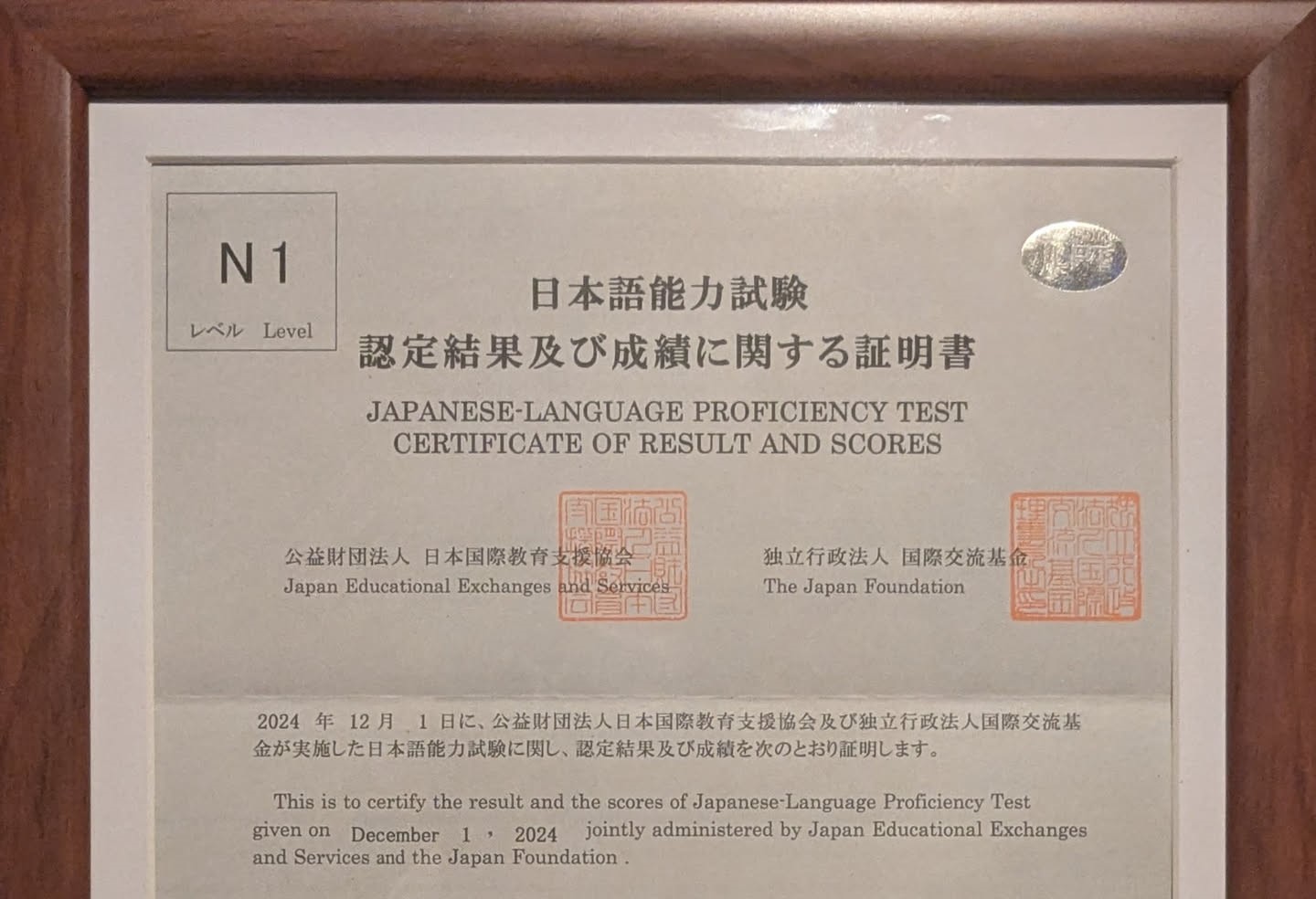
I did it. I actually passed the N1. The very test that I thought was impossible back in 2019. The very test where I looked at everyone else who had passed, and thought they were Japanese masters and at a level that I could never obtain. But I did it. 6 years later through hard work, perseverance, daily speaking with Japanese people and going through all 60 levels of WaniKani; I finally did it. I conquered the JLPT. No one can take that away from me.
At the end of the day, the secret to learning Japanese and passing the JLPT is not really a secret at all. It is just simply perseverance and not giving up. Just don't give up. That's literally it. It took me 6 years to get to where I could pass, but I did it. And for any Japanese learner who is reading this too, you can pass the N1. If I can do it, you surely can. I could barely form a sentence in 2019. I got nervous even saying thank you in Japanese. But here I am today having full conversations daily in Japanese and not even thinking twice about it. It's just simply a second language I speak now.
I am still not completely fluent in the language and maybe never will. But I know if I can pass the N1, I can pass anything I put my mind to. I still am learning Japanese, although I am currently mainly focusing on getting IT certifications right now. After I get some more IT knowledge and a higher salary, I would like to return to more in depth Japanese studies. But for now I will take this victory and start preparing for the next.